CASE STUDY
REVEAL
Leading the redesign and evolution of a cellular trail camera platform that replaced manual SD card workflows with a connected, cloud-based experience.

ROLE
Senior Product Designer
TIMELINE
2022 to 2025
PLATFORM
Multi-platform
COMPANY
Tactacam
OVERVIEW
EXECUTIVE SUMMARY
REVEAL helps hunters, landowners, farmers, and wildlife observers remotely manage cellular trail cameras and the media they capture, replacing the manual process of retrieving and organizing SD card files. As Tactacam’s first in-house product designer, I led the core experience, visual direction, and design system. From November 2022 to September 2025, I helped evolve the product through version 5.0 and created a scalable foundation for future growth.
CONTEXT
USER PROBLEM
Traditional trail cameras required users to visit each camera, remove the SD card, transfer and organize the files at home, and return to reinstall it. This was especially inefficient for people managing multiple cameras across large properties. Users needed a simpler way to access, organize, and share media remotely.
CONSTRAINTS
Cellular connectivity and variable signal quality, camera firmware compatibility, slow media synchronization, high-volume photo and video libraries, limited offline access, third-party dependencies, support for older camera models, cross-platform consistency, accessible contrast, and scalable typography.
GOALS
The goal was to increase adoption of Tactacam’s cellular cameras, grow recurring revenue, and improve customer retention. For users, that meant making it easy to connect and manage cameras, access and organize media remotely, and share content securely. Success was measured through activation, onboarding, subscriptions, retention, feature adoption, app store ratings, and support volume.
BUSINESS CONTEXT
Tactacam was expanding beyond one-time hardware sales by connecting its trail cameras to a subscription-based digital experience. REVEAL used cellular connectivity to bring cameras, media, settings, storage, and subscriptions into one platform, giving users remote access while creating recurring revenue through camera plans and cloud storage.
RESEARCH & DISCOVERY
We built on existing customer research with two rounds of remote usability testing, product analytics, app store reviews, and support feedback. I helped test the homepage, filters, camera setup, and settings to identify what added value and what created unnecessary complexity.
01
CORE TASKS FIRST
Testing showed that users cared more about managing cameras, reviewing media, checking device status, and sharing content than social features. We removed low-value features and focused the experience on these core tasks.
DESIGN IMPLICATION
Focus on camera management, media organization, and secure sharing.
02
SHARED CAMERAS IN ONE PLACE
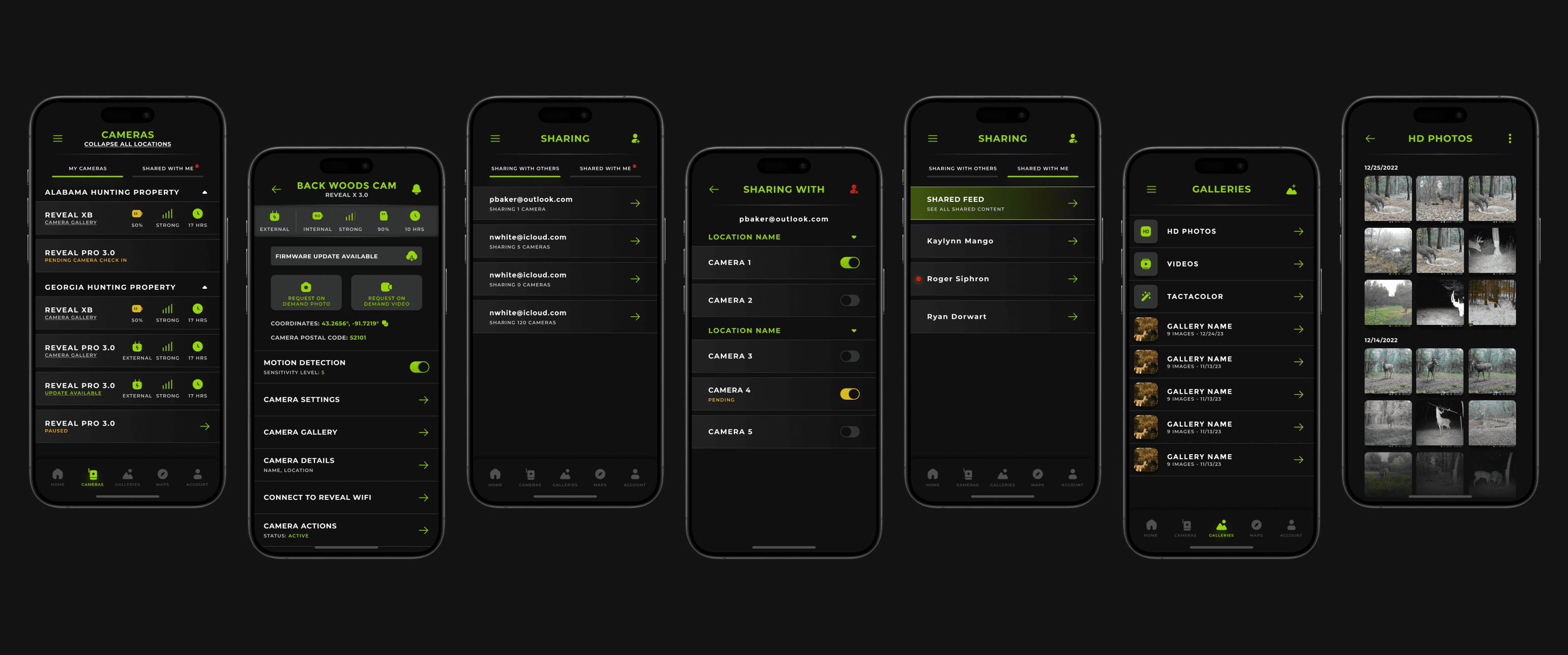
Users expected shared cameras to appear alongside their own. We introduced invitation-based access so people could collaborate without sharing credentials or transferring ownership.
DESIGN IMPLICATION
Show owned and shared cameras together in My Cameras.
03
FASTER ACCESS TO CAMERA SETTINGS
Users needed quick access to settings, battery, signal, and device status. We simplified the flow so key controls were easier to find, especially for people managing multiple cameras.
DESIGN IMPLICATION
Make settings and camera health easier to access.
PRODUCT STRATEGY
Our goal was to simplify the trail camera experience while creating a scalable platform. Rather than building a standalone app, we designed REVEAL to support a growing ecosystem of cameras, subscriptions, and connected features.
01
SIMPLIFY CAMERA MANAGEMENT
Make it easy to activate, manage, and monitor cameras, whether users have one device or many.
WHY IT MATTERED
Users needed confidence that their cameras were connected and working properly without visiting them in person.
02
BUILD FOR PRODUCT GROWTH
Create a scalable foundation for new features, camera models, and subscription services.
WHY IT MATTERED
REVEAL needed to grow without compromising consistency or requiring major redesigns.
03
TURN CAPTURES INTO ACTIONABLE INSIGHTS
Bring together maps, weather, and animal activity to help users make better hunting decisions.
WHY IT MATTERED
Photos alone weren't enough. Users needed context to understand patterns and decide when and where to hunt.
KEY DESIGN DECISIONS
Choosing Familiarity Over Immersion for the Home Feed
PROBLEM — The home feed needed to prioritize photos and videos while keeping camera information and key actions easily accessible.
ALTERNATIVES — Full-screen immersive feed; Information-heavy card feed; Media-first feed with familiar interaction patterns.
CHOSEN DIRECTION — We chose a media-first feed that balanced visual content with camera details and quick actions.
WHY — It made media easy to browse without sacrificing context, while relying on interaction patterns users already knew.
TRADE-OFFS — The experience was less immersive than a full-screen feed but significantly easier to navigate.
OUTCOME — After presenting and comparing all three concepts, the team selected the balanced approach as the foundation for the final home experience.


Sharing Camera Access Without Losing Ownership
PROBLEM — Multiple people often needed access to the same camera, but allowing duplicate registrations created ownership, privacy, and billing issues.
ALTERNATIVES — Allow multiple camera registrations; Share account credentials; Invite another REVEAL account to access the camera.
CHOSEN DIRECTION — We adopted an invitation-based sharing model where the owner kept full control while granting access to other users.
WHY — It protected ownership, avoided shared logins, and gave each user their own account and permissions.
TRADE-OFFS — Shared users needed a REVEAL account and permissions had to be clearly defined.
OUTCOME — Shared cameras were integrated directly into My Cameras instead of being separated into a different section.
Building a Scalable Design System
PROBLEM — REVEAL was growing quickly across platforms and features, but there was no shared design system to ensure consistency.
ALTERNATIVES — Design features independently; Use a generic UI library; Build a dedicated design system.
CHOSEN DIRECTION —We created a scalable design system with reusable components, patterns, and guidelines.
WHY — It improved consistency, sped up development, and made it easier to scale the product across teams and platforms.
TRADE-OFFS — Building the system required more upfront effort and ongoing maintenance.
OUTCOME — Design system became the foundation, reducing rework, improving collaboration, and later serving as the basis for another Tactacam product.

FROM STRATEGY TO PRODUCT
FINAL SOLUTION
The final product unified camera management, media review, sharing, and environmental insights into a single experience. It scaled from users managing one camera to those monitoring entire properties, while maintaining a consistent experience across mobile, tablet, and web.
Media-First Home
A familiar feed made it easy to review the latest photos and videos while keeping camera context and actions within reach.
Remote Camera Management
Users could activate, monitor, and manage their cameras from anywhere, reducing the need for field visits.
Smarter Hunting Insights
Maps, weather, and camera activity helped users better understand wildlife patterns and plan their next trip.
Secure Camera Sharing
Owners could safely share camera access with other REVEAL accounts without giving up ownership or account credentials.


RESULTS THAT MATTER
IMPACT
700K+
APP Downloads
324%
Revenue Growth
4.8 ★
Average rating
BUSINESS IMPACT — Tactacam reported 324% revenue growth between 2021 and 2024, fueled by the expansion of REVEAL cellular cameras and its subscription-based ecosystem.
PRODUCT IMPACT — Delivered a scalable experience that simplified camera management, media review, and remote monitoring for hundreds of thousands of users.
ORGANIZATIONAL IMPACT — Built a design system that improved consistency, accelerated product development, and was later adapted for another Tactacam product.
COLLAB & LEADERSHIP
PRODUCT STRATEGY — Partnered with Product Managers to define priorities, shape features, and align design decisions with business goals. Regularly presented work to founders and executive stakeholders.
DESIGN LEADERSHIP — Served as the primary design reference for the product by building the design system, defining UX standards, reviewing work, and helping other designers deliver consistent experiences.
ENGINEERING — Worked closely with engineers to validate feasibility, define implementation details, and balance technical constraints with user experience.
REFLECTION
01
What Worked
Building the design system early gave REVEAL a solid foundation to scale while keeping the experience consistent.
02
What I'd Improve
I would introduce design QA and product analytics earlier to validate implementations and make decisions with better data.
03
What I Learned
I learned that great product design is about more than interfaces. It requires balancing user needs, business goals, and technical constraints while building systems that scale.
KEY TAKEAWAY
My most valuable contribution was not a single screen or feature. It was building the experience, system, and shared design direction that allowed REVEAL to evolve across teams, platforms, and product releases.
NEXT PROJECT